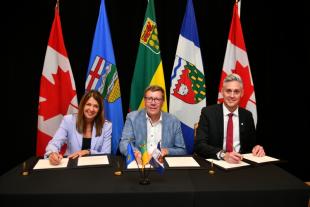
The governments of Saskatchewan, Alberta and the Northwest Territories have signed a memorandum of understanding (MOU) on nuclear energy with the goal of strengthening grid reliability and enhancing regional electricity transmission infrastructure.
The agreement establishes a framework for the three jurisdictions to work together to advance collaboration and information-sharing related to nuclear generation technologies, including large-scale nuclear reactors, small modular reactors, and microreactors. The MOU also supports efforts to explore enhanced regional transmission infrastructure between Alberta, Saskatchewan and the Northwest Territories.
As electricity demand continues to grow across Western Canada and the North, the three governments recognize the importance of working together to support reliable, affordable and sustainable electricity systems while enabling economic development and strengthening regional energy security.
“Reliable and affordable energy is essential to the future of the Northwest Territories. Stronger connections between our electricity grids could create real opportunities for the North,” said Premier R.J. Simpson.
“With new generation opportunities close to the NWT’s southern border currently being examined, we need to understand what that could mean for us and how we can benefit. This agreement will help us work with our neighbours, share information and explore potential grid connections, while positioning the NWT to take advantage of new energy opportunities in the region.”
The MOU is guided by three shared priorities: strengthening the affordability, security and reliability of electricity systems; supporting the evaluation of nuclear technologies as an economical pathway to carbon-neutral electricity generation; and exploring opportunities to enhance electricity transmission infrastructure across the region. The agreement respects the unique energy needs and priorities of each jurisdiction while providing a framework for ongoing collaboration.
Under the agreement, the three governments will collaborate on a range of priorities, including nuclear reactor technology selection and development, financing approaches, environmental assessment processes, regulatory and federal approval pathways, uranium fuel supply and transportation, and nuclear waste management.
The parties will also work together to examine electricity system needs and opportunities for enhanced transmission infrastructure, including new and expanded interties that could improve the movement of electricity between the three jurisdictions. Stronger regional interconnections have the potential to support the integration of a variety of generation technologies, including nuclear, hydro, wind, solar, natural gas and battery storage, helping improve reliability, enhance energy security and stabilize costs.
For media requests, please contact:
Press Secretary
Government of the Northwest Territories
presssecretary@gov.nt.ca