
10. State - People and Cultures
Le rapport sur l’état de l’environnement 2022 est un document technique destiné à un usage interne. Il n’est disponible qu’en anglais.
Introduction
The human population density in the Northwest Territories (NWT) is very low. In the NWT, life is intimately tied to the land. Residents depend on the land for food, medicine, materials, shelter, income, culture, spirituality, and recreation. For the NWT’s Indigenous peoples, relationships with the land have existed since time immemorial. Sustainable livelihoods are ‘a way of life connected to the land’1 and consider the plants, animals, water, air, people, relationships, processes, and connections that exist. Sustainable livelihoods include the capabilities, resources and activities that support a means of living in a way that is adaptable and resilient, while supporting continuation of those resources and activities now and for future generations2. Humans are one of the main driving forces influencing the environment. Indicators on human- population changes in each ecozone are helpful for analyzing and predicting how humans will drive future changes to our environment.

1 Note: ‘sustainable livelihoods’ is a broad term that can reflect many things, including health, income, housing and more. For this Action Plan, focus is on those activities that tie to land-based practices, though it is recognized that those activities fit within an individual’s overall livelihood.
2 Adapted from Chambers & Conway (1991), Sustainable rural livelihoods: practical concepts for the 21st century. IDS Discussion Paper 296; UNDP, p. 6.
10.1 Trends in demography in NWT ecozones
This indicator reports on changes in the number and density of people living in each ecozone in the NWT. Additional data on the proportion of NWT residents living in small, medium, and large communities, and on key demographic statistics and age distribution are also provided. Some statistics are only available for the NWT as a whole (i.e., the data are not reported by ecozone). For more information on the number of people who work in the NWT, but are not NWT residents, consult the NWT’s Economic Review documents (Ref. 4).

This indicator was prepared by the Government of the Northwest Territories, Department of Environment and Climate Change, using information obtained from NWT Bureau of Statistics and from Statistics Canada.
NWT Focus
Indigenous peoples have been living in the NWT since time immemorial. Each ecozone or ecosystem has fashioned a unique human culture and pattern of land use, so that people have defined themselves by where they live. Current patterns of habitation – numbers and densities – can inform our understanding of present and future links between human activities and environmental changes.
People are part of our environment and make decisions each day that will affect the future state of the NWT environment. These decisions are influenced by where we live.
Current view: status and trend
Population change in the NWT was modest from 2016 (44,556) to 2021 (45,520) (Ref. 1). Most of the population growth occurred in the NWT’s capital city - Yellowknife (Taiga Shield ecozone) (Figure 1).


Since 1999, the proportion of NWT residents living in Yellowknife (large community of over 10,000 residents) has increased slightly from 43% to 48%. About three-quarters (77%) of NWT residents live in a medium or large community (where medium is defined as greater than 1,000, but less than 10,000 residents) (Ref. 1) (Figure 2).


While the birth rate for the NWT remains higher than the Canadian average, it is declining (Figure 3). In addition, while our population is still younger (average 35.2 years, Figure 4).) compared to that of Canada in general (40.8 years) (Ref. 2), our average age is declining: the NWT population is aging (Ref. 2).
Most newcomers to the NWT come from other Canadian jurisdictions. In-migration to the NWT has been countered by out-migration from the territory. The two charts below identify migration sources and net migration to the territory (Figure 5, 6). A negative net migration indicates that each year, more people are moving out of the NWT than moving in.


Looking forward
The NWT Bureau of Statistics identifies that, unlike most of the rest of Canada, the NWT has experienced close to a 0% change in population over the last five years (Ref. 1).
According to NWT Bureau of Statistics, the NWT labour market is projected to have up to 17,650 job openings between 2018 and 2027. On average, there will be close to 1,800 job openings annually and a large majority will be replacement jobs (Ref. 5). These jobs may lead to increased population growth through in-migration in the future but significant out-migration has been a reality for the NWT for the past decades (Ref. 4).
Looking around
Compared to its territorial neighbours, the NWT population increase has been modest since 1995 (Ref. 1).

Find Out More
See ECONOMY for more information on NWT’s economic outlook and its links to the environment.
This indicator tracks population estimates. To find out more about the difference between the census and population estimates, go to https://www.statcan.gc.ca/en/hp/estima
Reference List
Ref. 1. NWT Bureau of Statistics. 2021. Population Estimates by Community https://www.statsnwt.ca/population/population-estimates/bycommunity.php
Ref. 2. Statistics Canada. 2020. Population Estimates, age distribution and median age. Available at https://www.statcan.gc.ca/eng/subjects-start/population_and_demography
Ref. 3. Statistics Canada. 2020. Table 13-10-0710-01, Death and Mortality Rates, By Age Group as of June 10, 2020. Available at https://www.statcan.gc.ca/eng/subjects-start/population_and_demography
Ref. 4. Government of the Northwest Territories: Economic Review 2021-2022 Dept of Finance. https://www.fin.gov.nt.ca/sites/fin/files/resources/budget_2021-economic_review.pdf
http://www.iti.gov.nt.ca/sites/default/files/economicoutlook2014report_1.pdf
Ref. 5. NWT Bureau of Statistics. 2021. Occupational Demand Projections – Northwest Territories: 2018-2027. Available at https://www.statsnwt.ca/labour-income/labour-market-outlooks/NWT%20Labour%20Market%20Outlooks%202018-2027_Final.pdf
Ref.6. Statistics Canada. 2021. Estimates of the components of demographic growth, annual Table: 17-10-0008-01 (formerly: CANSIM 051-0004) Available at https://www150.statcan.gc.ca/t1/tbl1/en/tv.action?pid=1710000801
Ref. 7. Statistics Canada. 2021. Population estimates, quarterly. Table: 17-10-0009-01 (formerly: CANSIM 051-0005) Statistics Quarterly. Available at https://www150.statcan.gc.ca/n1/en/catalogue/91-002-X
10.2. Trends in use of Indigenous languages in NWT ecozones
This indicator reports on changes in the percentage of Indigenous people (15 years and older) that can speak an Indigenous language within each ecozone in the NWT.
This indicator was prepared by the Government of the Northwest Territories, Department of Environment and Climate Change, using information obtained from NWT Bureau of Statistics and the Department of Education, Culture and Employment.
NWT Focus
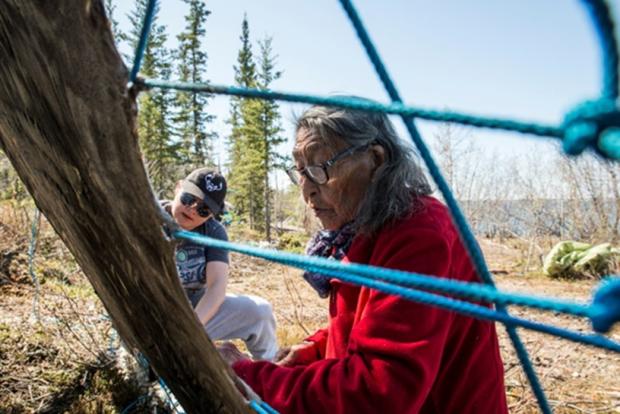
The land and language are intimately tied together which includes communicating information on animals, plants, rivers, lakes, land – the NWT’s environment. This interconnected relationship is described and understood in a variety of ways within the nine Indigenous official languages across the territory.
For example, the community of Whatì is located in an area that has been a good trapping area and Whatì means ‘marten’ in Tłı̨chǫ (Ref. 2). Knowledge transfer for trapping activities through the Tłı̨chǫ language is better understood and communicated in its original language. Preserving Indigenous languages is one way to help to preserve Indigenous knowledge (IK) through local place name recognition and Indigenous names of plants, species & geography. Indigenous languages contribute descriptive terms to ecological IK about local environments.
Current View: status and trend
The 2019 survey found that 33.2% of Indigenous people in the NWT, who are 15 years and older, could speak an Indigenous language. This is a decrease from the previous survey data collected in 2014 and continues the downward trend that has been observed since 1989 (Figure 1). When each language is examined individually (Figure 2), each appears to be experiencing declines in use, however, Chipewyan, North Slavey and South Slavey appear to be experiencing the greatest declines. The most widely spoken Indigenous language in the NWT is Tłįchǫ, used in both the Taiga Plains and the Taiga Shield (Figures 3 and 4), while the least spoken are Inuktitut and Inuinnaqtun, used in the Northern and Southern Arctic.


Looking around
A number of successful and effective language revitalization efforts are occurring in North America and around the world. Some of the most well-known efforts (the Navajo in the United States and the Maori of New Zealand) are well documented and provide useful information and perspective. UNESCO estimates that 75% of Indigenous languages in Canada are endangered, while globally they expect 50 to 90% of Indigenous languages to disappear by century’s end.” The “Status of Traditional Knowledge, Innovations and Practices” is an indicator tracked at the International level to assess progress towards biodiversity targets adopted under the Convention of Biological Diversity (Ref.4).
Programs use this indicator to track changes in access and the ability to safeguard traditional knowledge on biodiversity around the world. These organizations and programs compile information from the NWT, added to information from other regions in Canada and the world, and report back regularly on the state of Indigenous languages, to help reduce loss of both TK and biodiversity:

United Nations
Secretariat of the Permanent Forum on Indigenous Issues
http://www.un.org/esa/socdev/unpfii/documents/EGM_IL_SCBD.doc
Looking forward
Indigenous people have noted with great concern the decline of their languages. Retention and revitalization of Indigenous languages face a number of challenges. These challenges (e.g. value placed on dominant languages, communications technologies, etc.) must be addressed and opportunities must be realized for successful revitalization efforts.
The GNWT, Department of Education, Culture, and Employment (ECE), works with Indigenous Governments and community partners to fund, develop and support a wide range of projects that aims to promote and revitalize Indigenous languages (Ref. 5).
The NWT Indigenous Languages Action Plan (2018-2022), which acts as a blueprint for Indigenous languages and education in the NWT, has three ongoing actions to advance Indigenous language revitalization (ILR):
- Maintaining an overarching promotional campaign highlighting the importance of ILR in the NWT entitled: Learn, Speak, Live Our Languages;
- Partnering with six Indigenous Governments to deliver the 2022-2023 NWT Mentor Apprentice Program (MAP); and
- Annually offering $5,000 Indigenous Language Revitalization scholarships to up to ten NWT students competing a certificate, diploma or degree program, or other training that supports ILR.
MAP is a way of learning a language where a fluent speaker of the language (a mentor) teaches a language learner (an apprentice) through immersion. The goal of the program is to have apprentices increase their ability to understand and speak their language. The mentor and apprentice build Indigenous language fluency over a period of up to 200 hours of immersion by “living life in the language” while doing everyday activities using only their Indigenous language, with no English spoken.
Find out more
For more information on NWT’s official languages go to the Languages Commissioner of the NWT at https://olc-nt.ca/
For more information on the GNWT Traditional Knowledge Policy go to www.ecc.gov.nt.ca
References
Ref. 1. NWT Bureau of Statistics. 2019. Language Statistics. Available at: http://www.statsnwt.ca/language/
Ref. 2. Tłı̨chǫ Government. 2014. Traditional Knowledge of Whati. Available at: https://tlichohistory.com/en/stories/traditional-knowledge-whati
Ref. 3. Secretariat of the Convention on Biological Diversity. 2021. Article 8(j) – Traditional Knowledge, Innovations and Practices. Available at: https://www.cbd.int/traditional/
Ref. 4. United Nations Department of Economic and Social Affairs. International Decade of Indigenous Languages 2022 – 2032. Available at: https://www.un.org/development/desa/indigenouspeoples/indigenous-languages.html
Ref. 5. GNWT, ECE. 2021. Indigenous Languages Framework and Action Plan. Available at: https://www.ece.gov.nt.ca/en/ILES