
16. State - Species at Risk
Le rapport sur l’état de l’environnement 2022 est un document technique destiné à un usage interne. Il n’est disponible qu’en anglais.
Introduction
The loss of biodiversity is a global concern. The international community committed to halting the loss of biodiversity by 2020. However, despite continuing efforts, the global loss of biodiversity continues. The international community has now committed to slowing the loss of biodiversity by 2030.
Species at risk indicators are one way to measure progress towards these targets and beyond.
Most species in the NWT are not at risk of extinction. Many NWT species that are categorized as at risk nationally or internationally are at greater risk elsewhere in their distribution in Canada or the world. The NWT has responsibility for conserving the portions of these populations that found here in the NWT.

The Species at Risk indicators in this report provide status and trend information on all species known to be at risk in the NWT. An additional indicator provides information on threats to our species at risk. The information provided in these indicators is used for territorial, national and international reporting, and can be compared with indicators from other jurisdictions.
An additional indicator tracks performance in planning and actions taken to prevent species from becoming further at risk of extirpation; this indicator can be found in the Stewardship focal point.
16.1 Trends in the Species at Risk Index
This indicator tracks trends in projected (future) biodiversity loss in the NWT using the Species at Risk Index (SARI).

The SARI (or risk of species endangerment) tracks the risk of biodiversity loss based on the number of species at risk in an area (Ref. 5) and their current threat levels. This index allows us to track the likelihood of overall risk of species endangerment over the next 100 years assuming that current threat levels will continue in the future.
When the risk of overall species extinction worsens, the index goes up. When species are less likely to become extinct, the index goes down.
The SARI calculation is based on the Red List Index (Ref. 1). This index was adapted to measure global progress towards stopping biodiversity loss (Ref. 2). The index uses data from 2000 to 2020, including local knowledge and formal species status assessments, to track the risk of extinction from past decades to current and future projections. The next update for this indicator, with new data, is scheduled for 2025.
This indicator was prepared by the Government of the Northwest Territories, Department of Environment and Climate Change, using information obtained from the NWT Species General Status Ranking Program (Ref. 3), from Species at Risk Committee (SARC) status assessments in the NWT and Committee on the Status of Endangered Wildlife in Canada (COSEWIC) assessments (Ref. 4, 5). The index uses the quantitative criteria from the ranking and assessments to determine and project the risk of species extinction over the next century. The index provides a projected extinction risk that can be compared with risk projections from other regions of the world.
NWT Focus
As in all northern regions, the NWT is home to fewer species than more temperate and tropical regions, but each species is well adapted to the harsh and variable northern environment. Small food webs and life in extreme environmental conditions can change the overall resilience of northern ecosystems to local extinction. The effects of losing just one keystone species can have a significant and potentially irreversible impact on entire northern ecosystems. SARI provides a broad overview of how species in the NWT are doing. Both past and current extinction risks for NWT species can be tracked using the index.
Current View: status and trend
The 2020 SARI in the NWT is about 1%. This means that, based on current threats, about 1 in 100 tracked species in the NWT are at risk of becoming extirpated or extinct in the next 100 years. The overall index was also 1% in 2015, when the indicator was first reported.
Changes in the SARI for mammals illustrate how the index works. In 2000, the status of bowhead whale improved after 60 years of harvest restrictions. This resulted in a decrease in the SARI for this species. In recent years, the status of caribou has worsened (See Trends in Caribou indicator, Wildlife Focal point). This resulted in an upward trend in the SARI for this species and mammals (Fig. 1 mammals).

The risk of species endangerment for amphibians and reptiles has changed the most over the last two decades. The NWT is home to only five species of amphibians and one reptile, all of which are at the extreme northern edge of their range. Two species have been assessed as at risk of extirpation, bringing the overall index for this group higher than any other group. Similarly, 15 of the 58 species and sub-species of mammals in the NWT that are tracked are at some risk of extinction making the overall risk of endangerment for mammals higher than others.
Looking around
The Red List Index, a comparable index to the SARI, has been calculated for migratory birds of large-scale regions around the world. In 2004, the extinction risk for birds in the NWT was less than for birds in all other regions of the world. A similar index has not yet been calculated for other jurisdictions in Canada.
Looking forward
The risk of species endangerment for mammals, birds and fish in the NWT is increasing. New challenges, including increasing habitat change, facing species in the NWT due to climate change and new disturbances, may affect the SARI and probability of species survival.
Find out more
- For more information on the COSEWIC list: www.cosewic.gc.ca
- For more information on SARC: www.nwtspeciesatrisk.ca
- For more information on the Red List Index: www.iucnredlist.org/assessment/red-list-index
Technical Notes
Species At Risk Index (SARI)= (M-Tt)/M) expressed as a percentage, where M (maximum threat score possible for any one tracked species) = W*N and T (current threat score for any one tracked species) = summation of all status weight for all tracked species at time t. W is highest possible status weight (= 4) and N is number of species tracked. Scores are Extinct = 4, Endangered = 3, Threatened = 2, Special Concern = 1, Not at Risk = 0. Status categories follow COSEWIC or SARC definitions, as appropriate.
The SARI is based on the Revised Red List index (Ref. 1) and transformed 1-x, where x is original index. The range is from best = 0%, i.e., no species are at risk of becoming extinct, to worst = 100%, i.e., all species are in danger of becoming extinct. Tracked species (n = 2780) information is obtained from in the NWT Species General Status Ranking Program, and excludes alien species assessed as “Data Deficient” by COSEWIC or SARC (Ref. 4, 5) or ranked as “Undetermined” in the NWT (Ref. 3).
References
Ref. 1. Butchart et al. 2009. Improvements to the Red List Index. PLoS ONE 2:e140 doi:10.1371/journal.pone.0000140.
Ref. 2. Butchart et al. 2005. Using Red List Indices to measure progress towards the 2010 Target and beyond. Phil. Trans. R. Soc. B. 360:255-268.
Ref. 3. Working Group on General Status of NWT Species. 2021. NWT Species Infobase. Yellowknife, GNWT Available at: https://www.ecc.gov.nt.ca/en/services/biodiversity/nwt-species-general-status-ranking
Ref. 4. COSEWIC. 2021. COSEWIC Webpage. Available at: www.cosewic.gc.ca
Ref. 5. SARC. 2021. Species at risk at a glance. Available at: http://www.nwtspeciesatrisk.ca/SpeciesAtRisk
16.2. Trends in NWT populations of species at risk
The Committee on the Status of Endangered Wildlife in Canada (COSEWIC) (Ref. 1) assesses the status of species that may be at risk in Canada. The NWT Species at Risk Committee (SARC) (Ref. 2) assesses the status of species that may be at risk in the Northwest Territories. This indicator provides information on population trends for each NWT species that COSEWIC or SARC has assessed as a species at risk in Canada or in the NWT.

Trend information is noted as either “increasing”, “declining” or “stable”. Uncertainties are noted.
This indicator was prepared by the Government of the Northwest Territories, Department of Environment and Climate Change, using information obtained from the Committee on the Status of Endangered Wildlife in Canada (Ref. 1) and the Species at Risk Committee (Ref. 2).
NWT Focus
For many species found in the NWT, threats to the survival of the species are more severe in areas outside the NWT than within the NWT. For some species such as grizzly bear, wolverine, wood bison, boreal caribou, little brown myotis and northern myotis (bats), and yellow-banded bumble bee, the NWT is home to some of the few remaining healthy populations in North America or the world. Population status and trends for species at risk provide an overview of the current state of the most vulnerable components of northern ecosystems.
Current View: status and trend
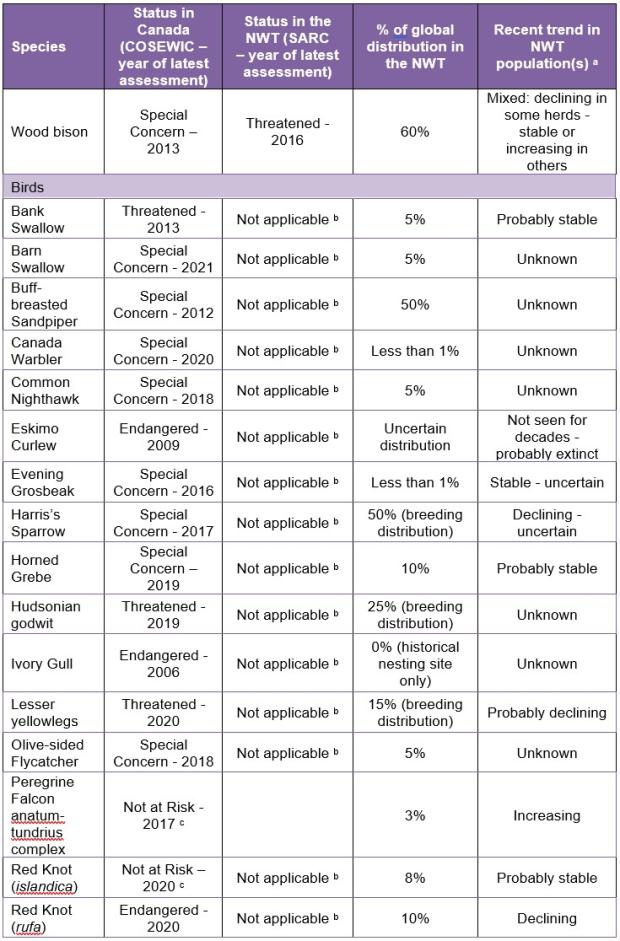
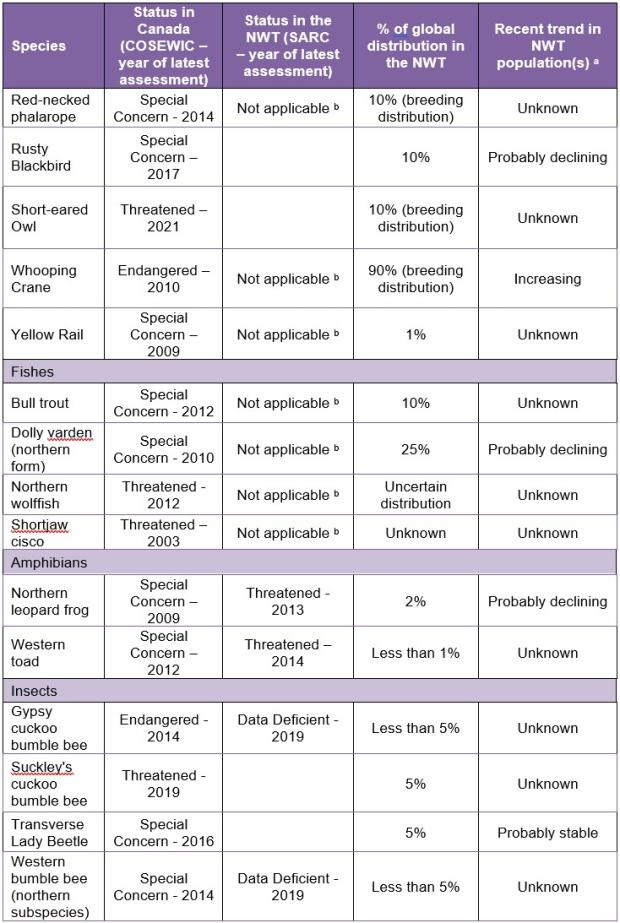
There are 50 species, subspecies, or distinct populations in the NWT that have been assessed by either COSEWIC or SARC as at risk of becoming extirpated or extinct. Of these, only three (3) species (6%), Peregrine Falcon, Whooping Crane and bowhead whale have clearly increasing populations in the NWT (Figure 1, species details in Table 1).
A total of 9 (18%) species at risk have declining population numbers (Figure 1). Trends are stable for 11 (22%) species at risk, and there are mixed trends (trends differ per populations, ecotypes, or subspecies) for another 5 (10%). Due to lack of monitoring programs, there is no data or information to determine the population trends for 22 (44%) species at risk in the NWT

Table 1: Species, conservation status as assessed by COSEWIC in Canada and by SARC in the NWT, the percent of the global distribution in the NWT, and the most recent trend in populations occurring in the NWT. Recent trends are summarized from the most recent COSEWIC or SARC status report for each species. Source: Ref. 1, 2.


A: Trends are described according to COSEWIC or SARC status reports for each species, whichever is the most recent.
B: The Species at Risk (NWT) Act does not apply to species strictly under federal responsibility: does not apply to aquatic species such as fish or marine mammals, or to migratory birds (as defined under the Migratory Birds Convention Act). These species are noted as ‘not applicable’ under the NWT process for this reason.
C: -Grey whale, peregrine falcon anatum/tundrius, and red knot islandica were previously assessed by COSEWIC as species of Special Concern.
Looking forward
Re-assessments are scheduled every 10 years. Seven species have not been re-assessed since 2010 or earlier (Figure 1). These species are scheduled to be re-assessed soon.
Most species for which we have little to no trend information are birds and insects. Increasing monitoring efforts and inventories will be essential to assess the status of these species in the NWT. How NWT’s management authorities plan to increase this capacity is tracked in the Stewardship: Planning and Adapting Indicator.
Find out more
For more information on species at risk in Canada: www.cosewic.gc.ca and in the NWT: www.nwtspeciesatrisk.ca
See Wildlife for other indicators on populations of species at risk. See Use of Renewable Resources for indicators on sustainable use of some species at risk.
Technical Notes
Estimates of percent of distribution are based on printed material and were rounded to the nearest 5%, except for values less than 5%.
Increasing, Declining, Stable = population trends in the NWT, as measured or inferred, based on written material in COSEWIC and SARC reports. Uncertain population trends are inferred based on expert opinion alone.
Unknown = population trend is not available and has not been measured or inferred based on any source.
References
Ref. 1. COSEWIC. 2021. Committee on the status of endangered wildlife in Canada. Available at: www.cosewic.gc.ca
Ref. 2. SARC. 2021. Species at risk committee. Available at: www.nwtspeciesatrisk.com/en/SARC
16.3 Status of threats to NWT species at risk
This indicator tabulates and scores all threats to species at risk in the NWT.
Each threat was scored using a modified version of the International Union for the Conservation of Nature’s standardized threat classification system (primary and secondary threat levels only) (Ref. 1). Threats were scored for entire species, subspecies, or distinct populations in the NWT.
This indicator was prepared by the Government of the Northwest Territories, Department of Environment and Climate Change, using information obtained a report on vulnerability assessment of species at risk to climate change and other threats in the NWT (Ref. 2).

NWT Focus
This indicator provides an overview of all threats to NWT species at risk. Biodiversity managers and conservation organizations can consider the feasibility of multi-species recovery actions by implementing management approaches that tackle key threats affecting many species. This indicator was completed with the understanding that no single threat to biodiversity acts in a vacuum; cumulative effects and interactions among threats are important to consider in terms of stress to species and impacts to their overall population trends (Ref. 3).
Current View: status and trend
Of the different threats to species at risk in the NWT, climate change and habitat change due to human development are considered threats to the greatest number of species (Figure 1).
Climate change acts as a threat directly as drought, temperature extremes, storm surges, and/or flooding (see Technical notes). Beyond acting as a threat or stressor in its own right, climate change has the potential to facilitate, accelerate, or aggravate other threats, such as increasing invasive species, pests, pathogens, and habitat changes (shifting/alteration) such as landslides, increasing shrubs on the tundra, fire regime shifts and others.
Habitat change can occur due to development for energy (oil and gas and hydro-development), mining, transportation (roads), service corridors, and to a lesser extent due to development for commercial, housing, and other activities such as agriculture and forestry.

The table in the technical notes provides more details of all known threats to NWT species at risk. Threats to a total of 46 species at risk in the NWT were assessed for this indicator: 2 amphibians, 14 mammals, 19 birds, 4 fish, 4 insects, and 3 plants.
Climate change and habitat change are not the only threats affecting species at risk in the NWT (Ref.2). Other threats include:
- Natural system modifications, such as changes in wildfire regime, competition from native species, changes in predation levels, declines in prey availability
- Human disturbance, such as noise from ground source and flights, as well as disturbance and ice breakup from marine shipping
- Resource use such as over-harvesting
- Diseases or problematic species, such as alien invasive species
- Pollution (water and airborne)
- Geological events, such as landslides, changes in natural springs outflow.
Looking around
The Arctic Biodiversity Assessment (Ref. 4) concluded that climate change is the most important threat to Arctic species.
In Canada overall, climate change is still considered a ‘potential’ or ‘unknown’ threat in species at risk assessments, reflecting uncertainties in the projections, scenarios, and responses of species (Ref. 5, 6) in other regions of Canada. The finding that climate change ranks so highly in the NWT as a threat to species at risk likely reflects the faster rate of warming in our region.
Looking forward
The types of threats that have the most impact on species at risk in the NWT are likely to change over time reflecting shifts in our economic activities; however, climate change is likely to remain the most important threat to species at risk in the NWT for the foreseeable future.
Technical Notes
The summary chart was created based on the detailed table below. The total number of species where each threat sub-category applied was summed (y) for low, medium, and high score levels. As the number of sub-categories in each threat category differ (sub-n: range: 1-6), the totals were normalized by dividing y by sub-n, and rounding to the nearest integral (y normalized). The normalized totals for categories 1,2,3, and 4 were summed to chart the Habitat change composite.
The table below provided more details on the threat vulnerability assessment for NWT species at risk. This was completed using a modified version of the International Union for the Conservation of Nature’s standardized threat classification system (primary and secondary threat levels only) (Ref.1). Threats were scored based on the assessment unit as a whole (species, subspecies, or distinct population) insofar as the threat may be directly relevant to wildlife managers in the NWT. Detailed scores and rationale, as well as scoring methods, can be found in Ref.2.
Legend: Grey = Threat not applicable or negligible, Blue = threat low, Orange = threat medium, Red = threat high.


References
Ref. 1. Salafsky, N., D. Salzer, A.J., Strattersfield, C. Hilton-Taylor, R. Neugarten, S.H.M. Butchart, B. Collen, N. Cox, L.L. Master, S. O’Connor, and D. Wilkie. 2008. A standard lexicon for biodiversity conservation: Unified classifications of threats and actions. Conservation Biology 22: 897-911.
Ref. 2. Singer, C. and C. Lee. 2021. NWT Climate Change Vulnerability Assessment: Species at Risk. Department of Environment and Climate Change, Government of the Northwest Territories, Yellowknife, NT. 166 pp. + appendices.
Ref. 3. Conservation of Arctic Flora and Fauna (CAFF). 2013. Arctic Biodiversity Assessment: Report for Policy Makers. Conservation of Arctic Flora and Fauna, Akureyrl, Iceland. 28 pp.
Ref. 4. Meltofte, H., T. Barry, D. Berteaux, H. Bültmann, J.S. Christiansen, J.A. Cook, A. Dahlberg, F.J.A. Daniëls, D. Ehrich, J. Fjeldså, F. Friðriksson, B. Ganter, A.J. Gaston, L.J. Gillespie, L. Grenoble, E.P. Hoberg, I.D. Hodkinson, H.P. Huntington, R.A. Ims, A.B. Josefson, S.J. Kutz, S.L. Kuzmin, K.L. Laidre, D.R. Lassuy, P.N. Lewis, C. Lovejoy, C. Michel, V. Mokievsky, T. Mustonen, D.C. Payer, M. Poulin, D.G. Reid, J.D. Reist, D.F. Tessler, and F.J. Wrona. 2013. Chapter 1 – Synthesis: Implications for Conservation. Pgs. 21-65 in Meltofte, H. (Ed.). Arctic Biodiversity Assessment: Status and trends in Arctic biodiversity. Conservation of Arctic Flora and Fauna, Akureyrl, Iceland.
Ref. 5. McCune, J.L., W.L. Harrower. S. Avery-Gomm, J.M. Brogan, A.-M. Csergo, L.N.K. Davidson, A. Garani, L.R. Halpin, L.P.J. Lipsen, C. Lee, J.C. Nelson, L.R. Prugh, C.M. Stinson, C.K. Whitney, and J. Whitton. 2013. Threats to Canadian species at risk: An analysis of finalized recovery strategies. Biological Conservation 166(2013): 254-265.
Ref. 6. Leaman, D. and A. Mooers. 2018. Addressing climate change as a threat in COSEWIC status assessments: species assessment meeting April 2018 update. Committee on the Status of Endangered Wildlife in Canada, Ottawa, ON. 2 pp.